Showing posts with label Zimbabwe. Show all posts

Wednesday, December 19, 2012

Big Game and Rare Painted Dogs

Hwange National Park, Zimbabwe, October 26, 2012

African elephant with giraffe
Our little group was returning to Ivory Lodge after a game drive. Hwange National Park, the largest national park in Zimbabwe, is home to huge numbers of wildlife. We had seen giraffes, elephants, cape buffalos, impalas, and a herd of zebras, apparently unconcerned about a black-backed jackal lurking nearby.

Burchell's zebra with jackal
Cape buffalo
Male impala
 
Female lion and cup feeding on young elephant
In Hwange we also had the amazing luck of seeing a pride of lions with the young elephant it had killed a few hours before. Our guide said that lions normally didn't hunt elephants, but Hwange is so overpopulated with elephants, it is just as well this pride has developed the skill necessary to bring down a huge pachyderm. Even a youngster is much larger than the largest lion.

         "I wish we could see a painted dog," I said, on our way back to lodge after a 5:30-8:30 a.m. game drive in Hwange. I had noticed a small sign that said "Painted Dog Conservation Area." 
        "Very unlikely," our guide Peter replied.
          We had heard about this rare, elusive, endangered carnivore, one of the best hunters in Africa, unrelated to domesticated dogs.
            Two minutes later, Peter suddenly braked the land rover. Twenty yards away were five painted dogs. They were larger than I had expected, beautifully multi-colored, with big round ears. Some were asleep, some were lolling on the ground. Each one had distinctive black, tan, and white markings. Four of the dogs wore a collar with a tracking antenna, part of the effort to save them from extinction.
Painted dogs near Hwange National Park, Zimbabwe
            Peter said they must have just made a kill and eaten their fill. Their bellies were bulging, and they stood to change positions occasionally and then flopped down again.  They didn't seem bothered by our presence or Peter's soft voice.

Painted dog
            He said that painted dogs hunt collaboratively and efficiently, and they share the meat. If some dogs don't get enough to eat, the others will feed the still-hungry pack mates by regurgitating food. If a dog is too old or sick to hunt or is caught in a trap, they will return from a kill to feed it.
            Painted dogs don't fight for dominance. One pair breeds, and the rest of the pack helps raise the pups. If dogs reach sexual maturity and want to breed, they leave the pack, often with siblings, and look for other singles. Of those, just one pair will mate, and the aunts and uncles help take care of the puppies.


Male kudu
            Painted dogs are intelligent. In fact they may be capable of expressing gratitude. Peter told us about a man walking in the bush who came across a painted dog with its paw caught in a trap. Instead of snapping and snarling, the dog put its head on the ground and closed its eyes, allowing the man to release its foot.
            Freed, the dog sprang away but then circled back and trailed the man home. A few days later, a pack of dogs chased a kudu, a large antelope with spiraling horns, to this man's home, killed it in the yard, and then left...apparently, a thank-you gift!           


Wednesday, December 12, 2012

Victoria Falls, Out in Africa, part 2

Victoria Falls, October 28, 2012

Our little group arrives at the colonial Stanley and Livingstone.  As usual at Zimbabwean hotels, we are greeted with a cool washcloth and a glass of chilled fruit juice.The clerk sits at an enormous wooden desk with depictions of the famous 1871 meeting between the two explorers -- "Dr, Livingstone, I presume?" -- adorning the walls.
As Becky and I sign the guest book, the clerk says, "Are you sisters?"
My heart lodges in my throat. Homosexual acts are punishable by death in Zimbabwe. But the clerk looks nice, and I hope she will not create trouble for us.
"No." I make eye contact with her. "We're married."
She looked baffled.
"To each other," I add.
"Oh, that is good," she nods. "It is important to find someone you are compatible with."
All right then.
 
The next morning our group drives several miles to one of the seven wonders of the world, Victoria Falls. In the native Lozi language, it is called Mosi Oa Tunya, "Smoke That Thunders." It is spectacular, a mile across with a 100-meter vertical plunge, the largest sheet of falling water in the world.
We are here at the end of the long, hot dry season, so some sections of the falls are dry. In the rainy season, there is so much spray from the cataract that visitors may not see much. An early thunderstorm 5 days ago has swollen the Zambezi River, giving us an ideal experience. Plumes of spray shoot up into the sky, creating rainbows. As we stroll along a path toward the loudest thunder, mist blows into our faces and rains down on us. We're told that this is the only place on earth where it "rains" 24/7/365.

Instead of the parched, drought-stricken African scrub we've been seeing during our whole first week in Zimbabwe, we are breathing in the humid air of a lush tropical mini-rain forest. Giant split leaf philodendrons, palm trees, and monkey vines twist through dense vegetation, reminding us of the Costa Rican rain forest.

 
Gary, our leader,  originally from Zimbabwe, wants to take all three couples' pictures in front of the "kissing tree." John and Louise kiss in front of the tree. Then Becky and I take their place. My heart is pounding. Is a same-sex kiss a capital crime? Are we crazy to risk this? I glance around. There are no officials in sight. Remembering the friendly clerk at the Stanley and Livingstone and with our travel buddies present, I put my arms around Becky. She puts her arms around me, and we kiss. 
The big smoke and thunder are over at Victoria Falls, 100 yards away, but that kiss feels huge, our own personal Mosi Oa Tunya.
 

Friday, December 7, 2012

Africa is for the Birds

Lake Kariba, Zimbabwe, October 31, 2012

Nancy on houseboat, writing this update


Becky and I are sitting on a house boat on Lake Kariba, the largest human-made lake in Africa The river that goes over Victoria Falls upstream was dammed here 5 decades ago to create hydroelectric power. Our group is on a 2-day cruise, a good respite from the intense highway and safari driving of our first 9 days in Zimbabwe, and a chance to write.


There's a hippopotamus on shore, a rare sighting since they usually emerge from the water to feed only at night. The boat captain says that on a previous trip, he saw several lions on the shore feasting on a hippo they had just killed.


In front of us a dozen elephants deftly twist grass out of the ground and pop it into their mouths.

African elephants on Lake Kariba, Zimbabwe
 
lilac-breasted roller
These wild creatures take our breath away. So do the birds. They are all new to us,. Lilac-breasted rollers appear everywhere we went in Zimbabwe. A cozy pair of cinnamon-colored broad-billed rollers perch in front of our room at Chilo Gorge Safari Lodge. A southern ground-hornbill jumps up on a rock and displays its red throat and blue throat patch. A yellow-billed stork's scarlet face and bright pink legs are reflected in the water.


           At the elegant colonial Stanley and Livingstone Hotel near Victoria Falls, we wander through lush gardens, watching hundreds of southern masked weavers build nests from palm and papyrus fibers, weaving an entrance tube at the bottom of each structure.

Southern masked weaver entering its nest from the bottom
Becky's favorite bird so far is the long-tailed carmine bee-eater, spotted this morning from the houseboat. Africa is famous for its bee-eaters, and this is the first one we have seen.
 
Carmine bee-eater
One bird does something odd. From its perch on a branch over the lake, this long-necked cormorant-type bird spreads its wings and jumps webbed feet first into the lake! "What is that?" I ask our guide.

Another African darter (or "snakebird")
African darter
"That one is the African dah-tah." Becky writes it down in our notebook. African dah-tah. No stranger than the boubous, bulbuls, hamerkops, and tit-babblers we've already seen in Zimbabwe.

Back on the houseboat, as the sun sets flaming orange over Lake Kariba, we check our Birds of Southern Africa. Ahhh . . . African Darter! We should have guessed at our guide's British-Zimbabwean accent. After all, that isn't the fest bed (first bird) we've seen on the chahhed (charred) remains of a bent (burned) tree!
 

Tuesday, November 27, 2012

Zooming in Zimbabwe

               Over the next couple of weeks, Nancy and I will be posting reports on our 3-week adventure circumnavigating Zimbabwe, exploring four World Heritage sites and one of the Seven Wonders of the World, going on over a dozen game drives, seeing "the big five" and other African wildlife, and spotting over 100 species of birds new to us.
               We had hoped to post reports on the road, but the internet connection in both South Africa and Zimbabwe were very poor...and many nights we were just too tired to write.
               On Oct. 18 we began our adventure in Johannesburg, South Africa, where we stayed four days to recuperate from the 15-hour flight from Atlanta, GA. We joined the rest of our group:
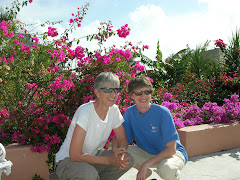
Canadians John & Louise (front row), Nancy & Becky (middle), and Canadians Eleanor and Dick (top row),
               The next day we all flew to Bulawayo, Zimbabwe, to join our guide, Gary Clegg (a native Zimbabwean, the owner of Shumba Tracks African Safari, and our neighbor in Costa Rica), and his British assistant, Kelly Geoghegan, head of a literacy program in Zambia.
              The eight of us traveled in a van, with our luggage stowed in a trailer. Gary drove and Kelly navigated on suprisingly good highways. The dirt roads into the national parts were another story!

Our Mercedes van and trailer at an overlook in the Eastern Highlands of Zimbabwe
               We'll start with our brief stay in Johannesburg and then go to Zimbabwe. For a taste of the wildlife to come....
Mother elephant warning us away from the babies, Gonarezhou National Park