Why did we enjoy our road trip in Mexico? First there’s the joy of beautiful and surprising sights, for example mile after mile of trees laden with oranges along the Gulf, thundering waterfalls and pine-forested mountains of Chiapas, a breathtaking flock of flamingos in the Yucatan, and the eighth most visited aquarium in the world in Veracruz. (See our February 4, 2011 posting)
Second, delicious and inexpensive regional specialties made from fresh ingredients, like the artistic mango-on-a-stick pictured in our February 10, 2011 posting. One noon we pulled into an open-air restaurant far from any town, right on the Gulf of Mexico. Within minutes, we were enjoying fresh red snapper, savory beans and rice, a stack of hot tortillas, several piquant sauces, and a cold beer, all for under $10.
Third, friendly, helpful people. Everyone was helpful and patient with my Spanish as I bought a cell phone, had my teeth cleaned, applied for a senior citizen card, and took violin lessons. Having a car meant Becky and I got to meet skillful, creative mechanics who went out of their way to solve the water leaks that plagued our rusty old Buick. My new friend on Isla Mujeres, Adolfo, welded patches over the rust holes and then escorted me to the hard-to-find local lavacar, where we had a satisfying discussion of 12-step recovery, parenting, and homosexuality while the car was being washed.
Fourth, a sense of competence in dealing with conditions that don’t exist at home. Being in a foreign country, much less driving long distances in one, stretches a person. It is fun and satisfying to accomplish something that seems difficult and scary.
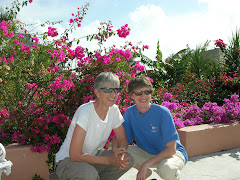
Fifth, day after day of compatible togetherness. Becky and I love road trips, and this one was especially sweet…probably because it was so adventurous. We worked well as a team. When one person was tired, the other seemed alert. We found ourselves talking through situations effectively, such as locating lodging or trying to figure out the procedure at the border. We loved listening to music and to books on tape. We read a novel out loud to each other—Water for Elephants. The long drives went by amazingly quickly.
People often asked us if we weren’t afraid of all the violence. We didn’t have any trouble and never felt in danger. The main threat we saw up close is to the economy of Isla Mujeres. Restaurants and hotel, including our Nautibeach Condos, were half empty because of people’s fears of Mexico. But Mexico is a huge country, and the Yucatan has a murder rate roughly equal to that of France.*
I’m grateful for the whole experience. Even so, next winter Becky and I will take a direct flight to Cancun. We’ll be breathing in that tropical air and gazing at the turquoise Caribbean waters about 3 hours after leaving Minneapolis!
*Minneapolis Star Tribune, Nov. 30, 2010, D8.
 mountains of Chiapas, a breathtaking flock of flamingos in the Yucatan, and the eighth most visited aquarium in the world in Veracruz. (See our February 4, 2011 posting)
 Second, delicious and inexpensive regional specialties made from fresh ingredients, like the artistic mango-on-a-stick pictured in our February 10, 2011 posting. One noon we pulled into an open-air restaurant far from any town, right on the Gulf of Mexico. Within minutes, we were enjoying fresh red snapper, savory beans and rice, a stack of hot tortillas, several piquant sauces, and a cold beer, all for under $10.
Third, friendly, helpful people. Everyone was helpful and patient with my Spanish as I bought a cell phone, had my teeth cleaned, applied for a senior citizen card, and took violin lessons. Having a car meant Becky and I got to meet skillful, creative mechanics who went out of their way to solve the water leaks that plagued our rusty old Buick. My new friend on Isla Mujeres, Adolfo, welded patches over the rust holes and then escorted me to the hard-to-find local lavacar, where we had a satisfying discussion of 12-step recovery, parenting, and homosexuality while the car was being washed.
Fourth, a sense of competence in dealing with conditions that don’t exist at home. Being in a foreign country, much less driving long distances in one, stretches a person. It is fun and satisfying to accomplish something that seems difficult and scary.
Fifth, day after day of compatible togetherness.
 Becky and I love road trips, and this one was especially sweet…probably because it was so adventurous. We worked well as a team. When one person was tired, the other seemed alert. We found ourselves talking through situations effectively, such as locating lodging or trying to figure out the procedure at the border. We loved listening to music and to books on tape. We read a novel out loud to each other—Water for Elephants. The long drives went by amazingly quickly.
 People often asked us if we weren’t afraid of all the violence. We didn’t have any trouble and never felt in danger. The main threat we saw up close is to the economy of Isla Mujeres. Restaurants and hotel, including our Nautibeach Condos, were half empty because of people’s fears of Mexico. But Mexico is a huge country, and the Yucatan has a murder rate roughly equal to that of France.*
I’m grateful for the whole experience. Even so, next winter Becky and I will take a direct flight to Cancun. We’ll be breathing in that tropical air and gazing at the turquoise Caribbean waters about 3 hours after leaving Minneapolis!
*Minneapolis Star Tribune, Nov. 30, 2010, D8.