Zimabwe,
October 23, 2012
Zimabwe,
October 23, 2012
"Cecil
John Rhodes and Leander Starr Jameson were partners. They were both gay,"
says Howard, our black Zimbabwean guide. Our assistant group leader Kelly crouches down to read the inscription.
Howard has
led us on a steep, windy climb in Matopo
Hills National Park to "View of the World," which the founder of Rhodesia, now called Zimbabwe, chose as
his final resting place.
 The view is
impressive. Granite outcroppings with huge circular rocks and upright
rectangular blocks perched precariously on top stretch to the horizon in all
directions. No one has a good explanation of how these balancing rocks came to
be, and they are one reason the Matopo Hills have been declared a UNESCO World
Heritage Site.
The view is
impressive. Granite outcroppings with huge circular rocks and upright
rectangular blocks perched precariously on top stretch to the horizon in all
directions. No one has a good explanation of how these balancing rocks came to
be, and they are one reason the Matopo Hills have been declared a UNESCO World
Heritage Site.
Despite
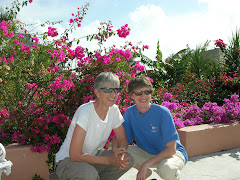
Howard's nonchalance about his nation’s founder being gay, Becky and I are
careful not to be too out in Africa. Homosexual acts in Zimbabwe are a criminal
offence punishable by death.
 Within minutes of arriving in Africa a week
earlier, however, we presented our passports to a South African immigration
officer, who asked, "Are you two sisters?" Since South Africa’s
constitution bans discrimination based on sexual orientation and since same-sex
marriage has been legal in South Africa for six years, we took a deep breath
and said, "No, we are married. To each other."
Within minutes of arriving in Africa a week
earlier, however, we presented our passports to a South African immigration
officer, who asked, "Are you two sisters?" Since South Africa’s
constitution bans discrimination based on sexual orientation and since same-sex
marriage has been legal in South Africa for six years, we took a deep breath
and said, "No, we are married. To each other."
"Really?"
she smiled. She knocked on the glass partition and called to the next immigration officer, "THESE LADIES ARE MARRIED TO EACH
OTHER!" He nodded and flashed
a smile.
“Welcome to South Africa!" she said, stamping our
passports. "Next!"
Four days later, when we entered Zimbabwe, the immigration officer did not ask if we were sisters. Thank goodness.
 My musings are interrupted by the discovery of a grasshopper next to Rhode's grave. Here in Africa, even insects seem more colorful, like the birds!
 My musings are interrupted by the discovery of a grasshopper next to Rhode's grave. Here in Africa, even insects seem more colorful, like the birds!
Nancy Manahan